


Lack of Demand for Contraceptives?
WASHINGTON, D.C., January 16 (C-Fam) A recent report from the pro-abortion Guttmacher Institute intended to promote increased funding for “sexual and reproductive health,” including family planning, admitted that, in fact, the majority of so-called “need” for contraceptives is made up of women who have expressed no openness to using them or have rejected them explicitly.
The latest edition of Guttmacher’s Adding It Up continues to promote the concept of an “unmet need” for family planning, which is often misconstrued by family planning proponents like the United Nations Population Fund (UNFPA) as a lack of access. In reality, as a 2016 report by Guttmacher reveals, only five percent of women described as having a “need” say the reason is lack of access.
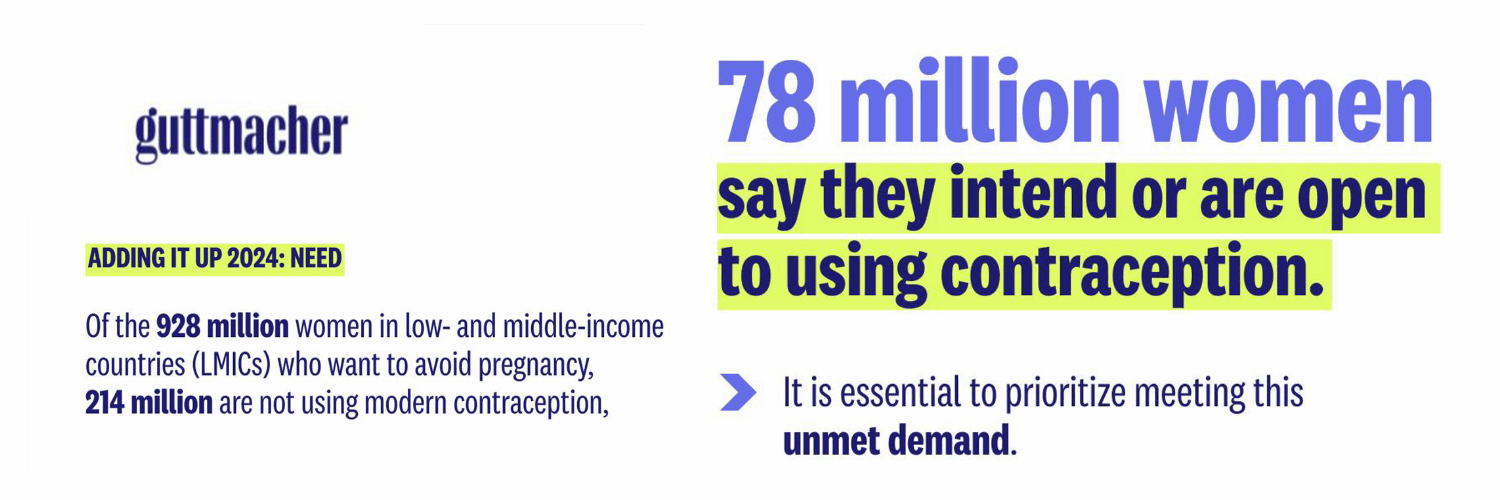
The new report introduces the concept of “unmet demand,” described as the “narrowest” subset of “unmet need,” which is made up of women “who want to avoid pregnancy and say they are interested in or open to using contraception in the future.” This category includes an estimated 78 million women—less than half of the total 214 million with “unmet need.”
The broader definition of “unmet need” includes women who want to avoid pregnancy but are not using a family planning method, regardless of the reason. This aligns with the metrics used in previous Adding It Up reports, as well as indicators in use at the United Nations for decades. However, as Guttmacher admits, “it is not the most appropriate estimate of actual need for contraception.”
This is because, when asked, most women with a “need” cite concerns about health risks and side effects of contraceptive methods, personal or religious opposition, or infrequent sex as their reasons for non-use. Based on the 2016 estimate that five percent of “unmet need” was due to lack of access, even most of the women in the narrower category of “unmet demand” are making a personal choice not to use contraceptives.
According to the Guttmacher Institute, “[f]ocusing on this [narrower] group helps prioritize limited resources.” However, they insist that “broader investments will ultimately be needed to reach the many other women who also face barriers to contraceptive care.” Based on Guttmacher’s own data, these “barriers” are likely to be women’s own priorities and decisions.
The Adding It Up report estimates that it would cost $104 billion a year to address the “unmet demand” for contraception, all maternal and newborn care, abortion services, and treatment for sexually transmitted infections for women in low and middle-income countries.
However, it emphasizes that “[e]very dollar spent on contraceptive services beyond the current level would save $2.48 in the cost of maternal, newborn and abortion care.” While this may sound like a way to reduce abortion, there are two important problems. First, it presumes that funding more contraceptives will result in increased use, despite the evidence coming from the same organization demonstrating that the market for family planning is approaching saturation.
Secondly, and more importantly, the Guttmacher Institute is calling for investment in “sexual and reproductive health” organizations that provide abortions and lobby for abortion in pro-life countries and are explicitly trying to siphon funding away from maternal and child health services in favor of contraception. This does nothing to build the basic health infrastructure required by the women who will want to become mothers, and their children, in the poorest regions of the world.
View online at: https://c-fam.org/friday_fax/lack-of-demand-for-contraceptives/
© 2026 C-Fam (Center for Family & Human Rights).
Permission granted for unlimited use. Credit required.
www.c-fam.org