

U.S. Criticizes Document on Human Trafficking

 By Iulia-Elena Cazan | 2025
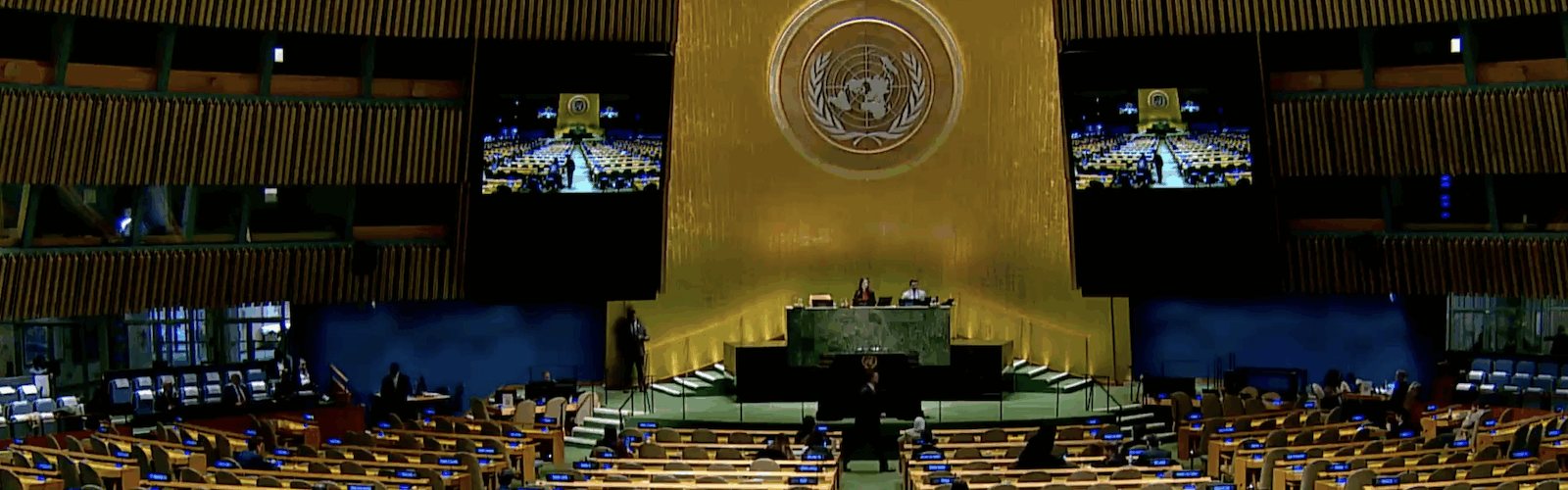
UNITED NATIONS, December 5 (C-Fam) The United States delivered a blistering attack on parts of a political declaration negotiated at a High-Level-Meeting on human trafficking.
The U.S. delegate said the Trump administration “expects these multilateral forums to deliver results, not rhetoric.” He went on to say the declaration “included topics unrelated to the actions necessary to address human trafficking effectively,” including references to contentious terminology such as sexual and reproductive health-care services.
The U.S. accepted the consensus on the document but specifically rejected some parts that are “superfluous at best, but also carry highly controversial meaning, often conflating these terms with notions of abortion, LGBTQ, or other sexual rights for children.”
At the summit, governments pledged to combat all forms of human trafficking, and several participants addressed the interlinkages between human trafficking and prostitution and encouraged governments to criminalize the purchase of sex.
Many governments raised alarm over the increase in human trafficking and the use of emerging technologies for trafficking purposes. Speaking for the UN Secretary-General, Guy Ryder said, “the number of children among detected victims has increased by one third since 2019” and that “women and girls remain the biggest share of detected victims worldwide and are trafficked mostly for sexual exploitation.”
The Russian representative said the scale of human trafficking remains “appalling” and that the fact that trafficking persists in all regions of the world has to do with the failure of the international community to find solutions to tackle the root causes. “These include the legalized sex industry and sex tourism, which establish a sustained demand for cheap and disenfranchised workforce,” the Russian diplomat continued.
Keynote speaker, Academy Award-winning actress, Mira Sorvino, board member of the UN Voluntary Trust Fund for Victims of Trafficking in Persons, said that commercial sexual exploitation “dehumanizes and commodifies marginalized individuals and the terminus point of all sex trafficking is prostitution.”
Sorvino explained that criminalizing the purchase of sex is “one of the only paths to a chilling effect on demand” and lamented that despite increasing global awareness about trafficking, convictions are not “nearly at the level of the actual scope of the crime.”
She said that full decriminalization of prostitution legitimizes pimps and traffickers and that there is a need for programs that help buyers heal and understand that “they contribute to a market whose very existence encourages more and more trafficking, more and more destruction of lives.”
In a written submission for the High-Level meeting, C-Fam, the publisher of Friday Fax, stressed that “[t]he effective abolition of sexual trafficking, which overwhelmingly involves the exploitation of women and girls, cannot be achieved in a context where the sale of sexual acts is tolerated and normalized.”
Despite growing evidence that prostitution constitutes a system of violence, which harms women and girls and reduces their bodies to “mere commodities”, as repeatedly stated by UN Special Rapporteur on Violence Against Women and Girls Reem Alsalem, the broader UN system, and UNODC in particular, refuse to condemn prostitution.
The World Health Organization (WHO) and UNFPA, the UN agency for sexual and reproductive health, have gone as far as to frame prostitution as a dignified profession by referring to it as “sex work.”
Notwithstanding this public reckoning, the Political Declaration adopted at the High-Level meeting did not address prostitution.
View online at: https://c-fam.org/friday_fax/u-s-criticizes-document-on-human-trafficking/
© 2026 C-Fam (Center for Family & Human Rights).
Permission granted for unlimited use. Credit required.
www.c-fam.org