

General Assembly President Openly Disdains U.S.
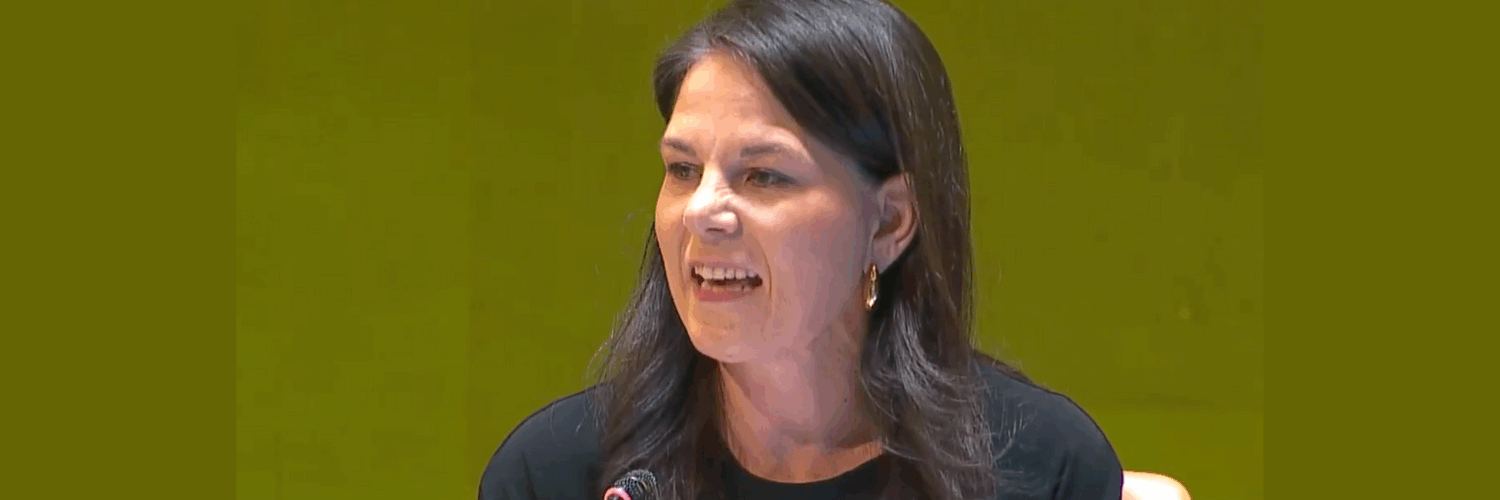
UNITED NATIONS, December 19 (C-Fam) The German President of the UN General Assembly, Annalena Baerbock, does not like the U.S. government under Donald Trump and her disdain is palpable.
This week she controversially pushed a global health agreement over the objections of the U.S. government. A U.S. delegate challenged the legality of Baerbock’s action, saying that the agreement had been presented “improperly.” Baerbock sat stone-faced at the head of the General Assembly and simply insisted, “I have submitted the draft resolution” and that the agreement had “broad support.” Throughout this testy exchange, she refused even to look down from the podium in the direction of the U.S. delegation.
U.S. Secretary of Health and Human Services, Robert F. Kennedy had rejected the agreement because of concerns about the World Health Organization, gender ideology, abortion-related terms, and climate policy.
Baerbock’s was a calculated gamble to isolate the Trump administration, and it worked. The U.S. called a vote to challenge Baerbock’s actions and lost by 151 to 3. Only Argentina and Israel voted with the U.S. on the procedural motion.
Baerbock is outspokenly opposed to the Trump administration and other conservative countries she believes are standing in the way of progress on globalist goals like climate, gender, and abortion. “Even when we face setbacks and frustrations, when diplomacy fails us, and consensus eludes us, we will unite to deliver for the people of the world. We will unite to defend the principles of this institution,” Baerbock said in her first speech to the General Assembly in September. This was widely seen as a challenge to the Trump administration, and it proved to be so.
The U.S. delegate said that Baerbock’s actions on Monday afternoon were illegal based on the procedure that had been agreed by the General Assembly for the adoption of the health agreement in the first place. This required the President of the General Assembly to present a document that had been negotiated and agreed “by consensus”, which means by unanimous consent of all the countries negotiating the agreement. In essence, the agreement should not have anything controversial or objectionable to any nation.
After the agreement was adopted, the U.S. delegate said that “consensus was not reached on the declaration to allow for its approval at the high-level meeting, and therefore no political declaration exists.”
At the UN it is desirable that high-level political declarations such as this are agreed by consensus. That is why the resolutions that establish the manner for negotiations and adoption normally require “consensus.” Progressive governments increasingly see consensus as an obstacle to adopting their agenda, and there have been repeated calls to disregard consensus in favor of majority rule. Baerbock has placed herself squarely in this camp with her actions and declarations.
The lack of support for the U.S. procedural motion reflected the broad support for international health policy from poor and small countries. Most developing countries view international cooperation on health issues to receive international health assistance from wealthier countries. They would find it hard to block the adoption of an agreement they view as beneficial, especially on procedural grounds.
Baerbock’s disdain for the Trump administration increased significantly on Wednesday when the General Assembly voted to remove sexual orientation and gender identity from a resolution on persons with disabilities. Baerbock’s colleagues in the European Union disdainfully referred to it as the “Trump amendment” even though it was initiated by the Organization of Islamic Cooperation.
View online at: https://c-fam.org/friday_fax/general-assembly-president-openly-disdains-u-s/
© 2026 C-Fam (Center for Family & Human Rights).
Permission granted for unlimited use. Credit required.
www.c-fam.org