

Why Won’t Hungary Defend Values at the UN?
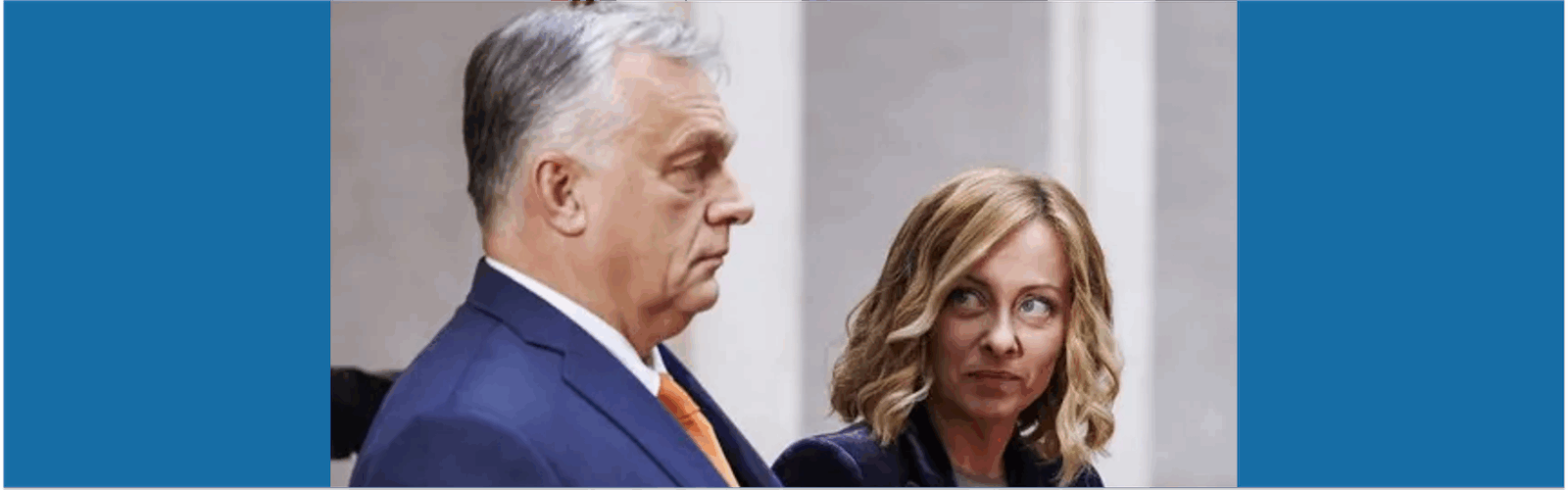
UNITED NATIONS, January 9 (C-Fam) Conservatives in the United States are surprised to learn that at the United Nations, the supposedly conservative governments of Giorgia Meloni and Viktor Orban stand in contradiction to their own political rhetoric and in lockstep with the most radically leftist positions of the EU bureaucracy, including on such controversial issues as gender, abortion, sexual orientation, and censorship.
For instance, when there was a vote to remove “sexual orientation and gender identity “at the General Assembly last month, both governments voted to keep the pro-gay/pro-trans language. In this, they followed the lead of the left-wing European Union.
When issues like these arise at the UN, these delegations do not reflect their own conservative values but rather uniformly follow the lead of the European Union. Some may wonder if these delegations are required by EU law to follow the consensus of the majority. This is not the case, but it is one of the many excuses given for taking these positions that more reflect Germany than Italy or Hungary.
The member states of the European Union do try to follow a common foreign policy that is formulated at meetings of something called the European Council which meets several times a year and is comprised of the heads of all 27 member states of the European Union, along with the powerful president of the European Commission. Ostensibly, all foreign policy decisions are made by this body and then passed along to the member states of the European Union.
However, the EU bureaucracy has no legal tools to stop European governments from adopting their own UN negotiating positions. But, for the most part, no European governments do, including the ostensibly conservative Italy and Hungary. The reality of European integration is such that European governments grow less willing and even less capable of developing their own positions. Their muscle of sovereignty seems to have atrophied over time.
EU law does require member states to follow the EU lead on issues of trade and development, but EU member states seem to have also given this power to the European institutions in matters of social policy at the UN.
Though the agreements worked out by the European Council are not binding on member states, they are binding on the EU bureaucracy, which uses the agreements to insist that European delegations at the United Nations support the most extreme social policies on abortion and gender ideology. The European Council can also adopt binding internal regulations on matters covered by EU treaties. Such regulations become binding law for all European governments when it is adopted by a qualified majority of the Council and the European Parliament.
The right of European governments to adopt their own foreign policy is such that even after the European Council reaches a unanimous position on a foreign policy issue, European governments retain the sovereign right to adopt their own positions. At the United Nations, they can develop their own negotiating positions even if these positions contradict the common EU policy. The EU Commission cannot do anything about it. This is in stark contrast to internal EU regulation, where the EU Commission has strong enforcement powers, including the power to impose sanctions against European states that do not comply with binding EU regulation, such as they have done on Hungary with regard to immigration.
So, if there is no legal restraint on conservative governments to go their own way at the UN, why do they allow the EU bureaucrats to commandeer their negotiating positions at the United Nations? Why do they never break the EU consensus on these issues. That is a difficult question to answer.
Hungarian officials have told the Friday Fax that nothing they do at the UN is in conflict with their domestic laws, which is hardly the point. The positions they take might not conflict with domestic laws, but they do conflict with the image they have sold to American conservatives, including pro-life and pro-family groups for going on twenty years.
Clearly, there is a disconnect between domestic Hungary and foreign policy Hungary.
Others connected to the highest levels of the Hungarian government have said what happens at the UN is not that important and they have tended to mock the concerns of American critics.
Hungarian diplomats have defended the EU’s policy positions when challenged by the Friday Fax, including language in UN agreements promoting abortion, gender ideology, undermining parental rights, and even a UN treaty to criminalize opposition to homosexuality and transgender ideology.
One thing is certain. When something does matter to the Hungary government, they become a less compliant delegation, and they do not hesitate to act on their own. They act aggressively and with sophistication, as when they challenge UN agreements on migration. They just haven’t done so on issues that matter to social conservatives.
View online at: https://c-fam.org/friday_fax/why-wont-hungary-defend-values-at-the-un/
© 2026 C-Fam (Center for Family & Human Rights).
Permission granted for unlimited use. Credit required.
www.c-fam.org