

Gender Radicals Retreat at UN
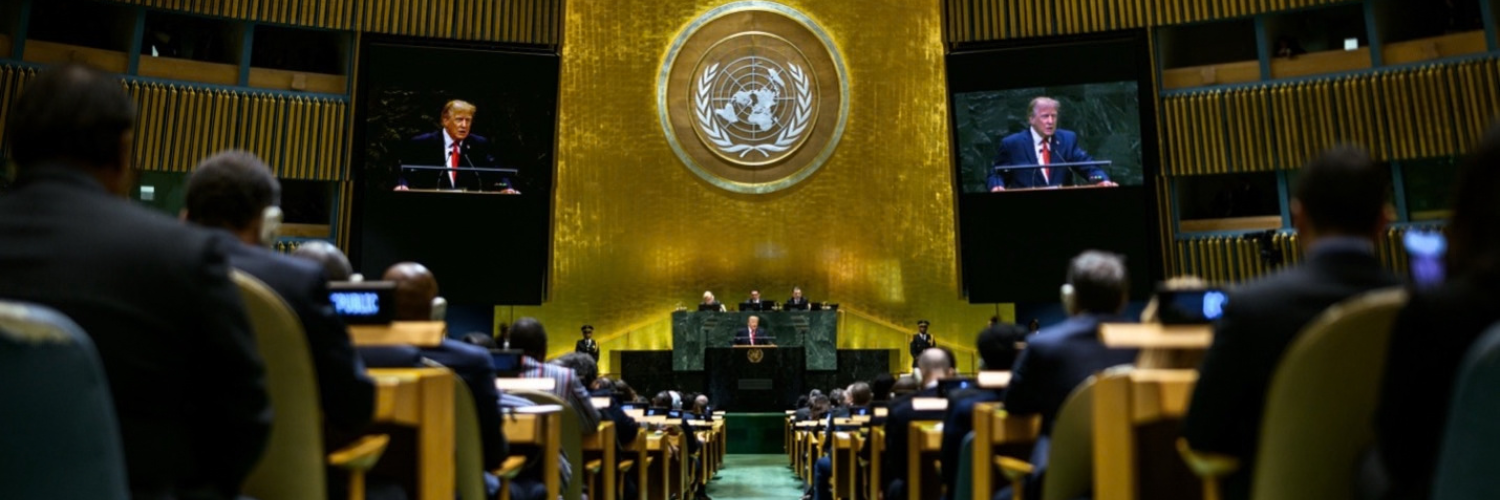
UNITED NATIONS, October 2 (C-Fam) World leaders known to be vocal supporters of abortion and gender ideology held back and stayed quiet in their speeches at the General Assembly last week. Is this part of what abortion radicals are calling the “anti-rights push back?”
“It is unacceptable that with all the atrocities in the world, the UN’s top human rights officials spend their time criticizing the United States for protecting our children from transgender mutilation and transgender insanity and enforcing our immigration laws,” President Trump told world leaders in his official speech.
President Trump was not alone. A growing chorus of world leaders criticized gender ideology and UN activism on controversial social policies during the high-level debate of the General Assembly last week.
The President of Türkiye, Recep Tayyip Erdoğan, was critical of international efforts to promote gender ideology and said it was a threat against the traditional family. “Global gender neutralization policies have turned into a siege targeting children and the institution of the family. We can only break the siege by protecting the family as consisting of a woman and man.”
President of Peru, Keiko Sofía Fujimori Higuchi, also complained that interference by international mechanisms into domestic politics was a threat to democracy. “Peru, as other Latin American countries, has seen agendas imposed upon us that have divided us as a society, politics have been instrumentalized, democracy has been eroded, and the institution of the family has been weakened,” she said, calling the family a “crucial” institution for the people of Peru.
“We believe in the family as an irreplaceable pillar of our society. We believe in respecting tradition. We believe in equality before the law and human dignity,” she said at the conclusion of her speech. She also urged international institutions to respect national sovereignty. “The world does not require identical democracies. It requires legitimate democracies. It does not demand nations that are all the same. It does not need cookie cutter nations. It needs truly free peoples.”
The President of Argentina, Javier Milei, also complained of the UN’s “gender agenda” alongside other progressive UN policies. He said the organization ran the risk of becoming a “useless organization whose only purpose is to sustain a cast of fatally arrogant parasites, masquerading as well-intentioned bureaucrats” and a “bureaucratic Leviathan devoted to deciding how the peoples of the world and their citizens should live.”
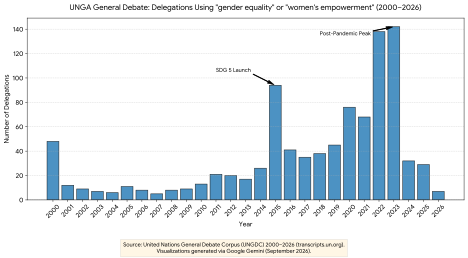
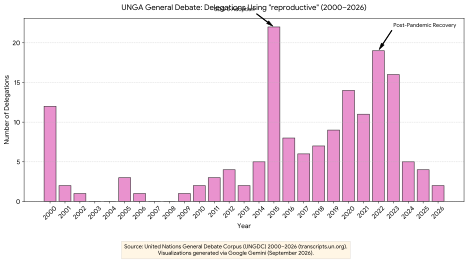
Leaders of progressive countries stayed mostly muted. This year had the lowest number of references to feminist priorities in speeches by world leaders in the UN general debate since the early 2010’s, including “reproductive health” and gender ideology terminology (see figures below).
Seven world leaders spoke of the importance of “gender equality,” in addition to the EU official statement and the statement of outgoing UN Secretary-General Antonio Guterres. The only representatives of nations who promoted LGBTQI+ issues were the Taoiseach of Ireland, Micheál Martin, and the Foreign Minister of Belgium, Maxime Prévot.
Some delegations made up for their silence in the UN general debate by participating in side events that take place each year on the margins of the official UN meetings. But even there, the tone of the events was defensive. UN High Commissioner for Human Rights Volker Türk complained of a “deep, coordinated, and comprehensive onslaught” at an event of the LGBT Core group last week, a group of some thirty states committed to promoting LGBTQI+ issues at the United Nations. Similar statements were made in reference to reproductive rights and gender issues by leaders of feminist organizations during side events.
View online at: https://c-fam.org/friday_fax/gender-radicals-retreat-at-un/
© 2026 C-Fam (Center for Family & Human Rights).
Permission granted for unlimited use. Credit required.
www.c-fam.org