

UN General Assembly Set to Clash
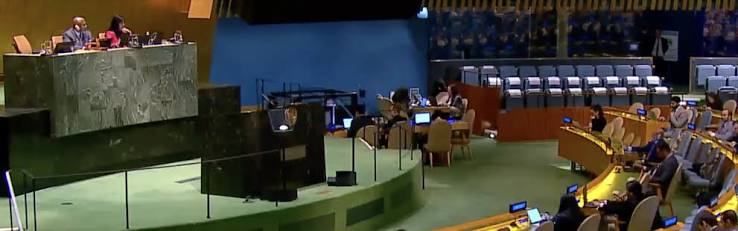
UNITED NATIONS, September 18 (C-Fam) World leaders will flock to New York over the next two weeks to kick off the new session of the annual UN General Assembly. They are expected to address major geopolitical and economic trends, including the conflicts in Ukraine and Iran, U.S. tariffs, the emergence of artificial intelligence, and UN reforms. They are also expected to bring up hot-button social issues such as abortion, gender ideology, and censorship.
Social issues have gained prominence in UN negotiations over the past two years because of the Trump administration. Since Trump took office a second time, the United States government has adopted a hard line against UN activism on abortion, gender, and censorship.
Once world leaders are gone, over the next three months, the General Assembly will negotiate and adopt the bulk of 350 or so recurring resolutions that govern what the UN system can and cannot do, including on social policy.
The political trends in the Western hemisphere could be decisive in deciding the outcome of those negotiations. Aside from Brazil, Mexico, and Uruguay, Cuba and Nicaragua, all Latin American governments are in the hands of populist right-wing leaders. But the substantive positions of elected governments are not always translated into clear diplomatic directives in New York. There is a vast bureaucratic lag that generally prevents conservative governments from prevailing upon the entrenched priorities of the global diplomatic elite.
More importantly, the U.S. will have to convince developing nations to side with the United States against the EU bureaucracy, the United Kingdom, Germany, France, and other wealthy Western nations on social issues. In theory, this should not be too difficult because most developing nations are more socially conservative than Western nations. But Europeans have been successful in getting developing nations to sit on the fence to sidestep and block U.S. proposals. They want leftist social policy to remain a staple of UN programs. They urge governments to wait out the Trump administration, arguing that once Democrats regain control of Congress and the White House, the UN system will go back to business as usual.
For the moment they have prevailed. But already over the past year there were signs laying out a clear path to change UN policy. On several occasions, Europeans bent procedural rules to block a substantive vote that might have rolled back leftist social policies. It happened last fall when Europeans withdrew a resolution that governs the UN humanitarian response in emergencies, such as wars and natural disasters, rather than vote on U.S. amendments that would have added pro-life caveats to the resolution. It happened again when the U.S. proposed a resolution to define gender as only referring to men and women at the Commission on the Status of Women in March. The Europeans had to block a debate on that resolution using a highly controversial procedural vote. And it happened this summer when a resolution about mental health was withdrawn rather than face a vote that would have stopped UN promotion of sex-rejecting procedures.
It remains to be seen if the Trump administration can leverage the resources of the U.S. State Department to build a coalition of conservative governments to contrast the EU bureaucracy in the General Assembly. Central to this effort will be to convince developing nations that the U.S. is not interested in EU-style social engineering to promote abortion, gender ideology, sexual rights, or censorship, and that the U.S. government is a more reliable partner than other Western nations in the long run.
View online at: https://c-fam.org/friday_fax/un-general-assembly-set-to-clash/
© 2026 C-Fam (Center for Family & Human Rights).
Permission granted for unlimited use. Credit required.
www.c-fam.org